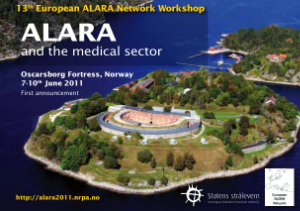
Programme and downloadable presentations
| Paper | Title, Authors |
|---|---|
| Welcome Fernand Vermeersch (EAN Chairman) |
|
| Session 1 - Introduction and Scene Setting - International organisations Chairperson: Gunnar Saxebøl (NRPA, Norway) |
|
| 1.1 | UNSCEAR - Data on medical exposures from a global point of view Ferid Shannoun (UNSCEAR) |
| 1.2 | ICRP and ALARA in the Medical Sector Madan M. Rehani (ICRP Committe 3) |
| 1.3 | WHO Global Intiative on Radiation Safety in Health Care Settings Maria del Rosario Pérez (WHO) |
| 1.4 | Medical exposure in the European Commission's proposal for revised Euratom radiation protection directive Georgi Simeonov (European Commission) |
| Session 1 (continued) - Introduction and scene setting - European societies and networks Chairpersons: Maria del Rosario Pérez (WHO), Jürgen Kopp (Central Clinic Augsburg, Germany) |
|
| 1.5 | Justification and Optimization of Chest CT Imaging in children Catherine Owens (ESR - European Society of Radiology, ESPR - European Society of Paediatric Radiology ) |
| 1.6 | European Association of Nuclear Medicine (EANM) - Overview of actions and initiatives on radiation protection with emphasis on ALARA Wolfgang Hechner (EANM) |
| 1.7 | Radiation protection and the implementation of the ALARA principle in radiation oncology - The perspective of European Society for Therapeutic Radiology and Oncology (ESTRO) Dag Rune Olsen (ESTRO) |
| 1.8 | European Federation of Organizations for Medical Physics (EFOMP) - Overview of actions and initiatives on radiation protection with emphasis on ALARA Stelios Christofides (EFOMP) |
| 1.9 | EFRS actions, initiatives and challenges on ALARA/radiation protection Graciano Paulo (EFRS - European Federation of Radiographer Societies, College of Health Technology of Coimbra, Portugal) |
| 1.10 | EURADOS - Overview of actions and initiatives on radiation protection Filip Vanhavere (SCK-CEN MOL, Belgium) |
| 1.11 | EMAN - The European Medical ALARA Network Anja Almén (SSM - Swedish Radiation Safety Authority , Sweden) |
| Session 2 - Tools for ALARA implementation in the medical sector Chairpersons: Caroline Schieber (CEPN - Nuclear Protection Evaluation Center), Wolfgang Eschner (EANM - European Association of Nuclear Medicine) |
|
| 2.1 | Challenge to justification and optimization - Individual health assessment using CT Jürgen Griebel (BfS - Federal Office of Radiation Protection, Germany) |
| 2.2 | Setting referral criteria for diagnostic imaging - The French guidelines for the clinical use of medical imaging Philippe A. Grenier (Pitié-Salpêtrière Hospital, University Pierre & Marie Curie, France) |
| 2.3 | The Swiss system for collecting population dose data and establishing DRLs: A web-based solution Abbas Aroua (CHUV - UNIL - University Insitute for Radiation Physics, Switzerland) |
| 2.4 | Clinical auditing and quality assurance as tools in the implementation of ALARA in the medical sector Hannu Järvinen (STUK - Radiation and Nuclear Safety Authority, Finland) |
| 2.5 | Introduction to Working Group sessions Peter Shaw (EAN secretary) |
| Session 3 - Practical ALARA implementation in the medical sector Chairpersons: Annemarie Schmitt-Hannig (BfS, Germany), Hilde M. Olerud (NRPA, Norway) |
|
| 3.1 | Endovascular Brachytherapy with Re-188 after PTA in the Peripheral Blood Stream - ALARA in handling Beta-Emitters Jürgen Kopp (Central Clinic Ausburg, Germany) |
| 3.2 | ALARA in Handling Beta-Emitters - Measurement Techniques and Optimisation Ilona Barth (BfS, Germany) |
| 3.3 | The use of resolution recovery software in nuclear medicine from an ALARA perspective Steve Ebdon-Jackson (HPA - Health Protection Agency, UK) |
| 3.4 | International project on individual monitoring and radiation exposure levels in interventional cardiology (ISEMIR) Renato Padovani (Udine University Hospital, Italy) |
| 3.5 | The ORAMED project: Staff dosimetry in interventional radiology and nuclear medicine Laurent Donadille (IRSN - Institute of Radiation Protection and Nuclear Safety, France) |
| Session 4 - ALARA culture in the medical sector Chairpersons: Fernand Vermeersch (SCK-CEN Mol, Belgium), Madan M. Rehani (ICRP) |
|
| 4.1 | Stakeholder Involvement in Medical Practices: Report on HERCA WG Medical Application Action Plan with the CT manufacturers Philipp Trueb (Federal Office of Public Health, Switzerland) |
| 4.2 | QA and optimization in diagnostic radiology - a multi-disciplinary task: How to build a regional service to implement ALARA Anne Catrine Traegde Martinsen (Oslo University Hospital, Norway) |
| 4.3 | The Norwegian Program on Quality Assurance in Radiotherapy (KVIST) - Organisation, Benefits and Experiences Taran Paulsen Hellebust (NRPA, Norway) |
| 4.4 | The work in IEC, DICOM and IHE in continuous development of standards to improve radiation safety and performance of radiological equipment, and exchange of information between imaging modalities Bernard Aubert (IRSN, France) |
| Session 5 - ALARA competence and skills in the medical sector Chairpersons: Annemarie Schmitt-Hannig (BfS, Germany), Hilde M. Olerud (NRPA, Norway) |
|
| 5.1 | Clinicians' justification of imaging: do radiation issues play a role? Lars Borgen (Buskerud Hospital and Buskerud University College, Norway) |
| 5.2 | Medical Physics Expert European Guidelines Stelios Christofides (EFOMP) on behalf of Eduardo Guibelalde (University Complutense of Madrid, Spain) |
| 5.3 | German recommendations on self-referred asymptomatic patients Birgit Keller (BMU - Federal Ministry for the Environment, Germany) |
| 5.4 | German situation on clinical audits Jürgen Kopp (Central Clinic Augsburg, Germany) |
| 5.5 | Experiences with focus on the medical sector from the IAEA IRSS mission to Spain Manuel Rodreguez-Marti (CSN - Nuclear Safety Council, Spain) |
| Session 6 - Feedback and Conclusions Chairpersons: P. Shaw, P. Croüail (EAN) |
|
| 6.1 | Report from the Working Group 1A: Challenges in the optimisation of patient and staff radiation protection in the medical sector (The PPT is the result of the Working Group discussions. It has not been modified by the Editorial Team) |
| 6.2 | Report from the Working Group 1B: Challenges in the optimisation of patient and staff radiation protection in the medical sector (The PPT is the result of the Working Group discussions. It has not been modified by the Editorial Team) |
| 6.3 | Report from the Working Group 2: Policy and Tools for Implementing the ALARA Principle in the Medical Sector (The PPT is the result of the Working Group discussions. It has not been modified by the Editorial Team) |
| 6.4 | Report from the Working Group 3: Education, training and communication to improve ALARA in the medical sector (The PPT is the result of the Working Group discussions. It has not been modified by the Editorial Team) |
| 6.5 | Report from the Working Group 4: Technical developments and quality assurance in the implementation of the ALARA principle in the medical sector (The PPT is the result of the Working Group discussions. It has not been modified by the Editorial Team) |
| 6.6 | Conclusions and recommendations |