Issue 51 - March 2024
- Details
You can access here the 51th issue of the European ALARA Network Newsletter. 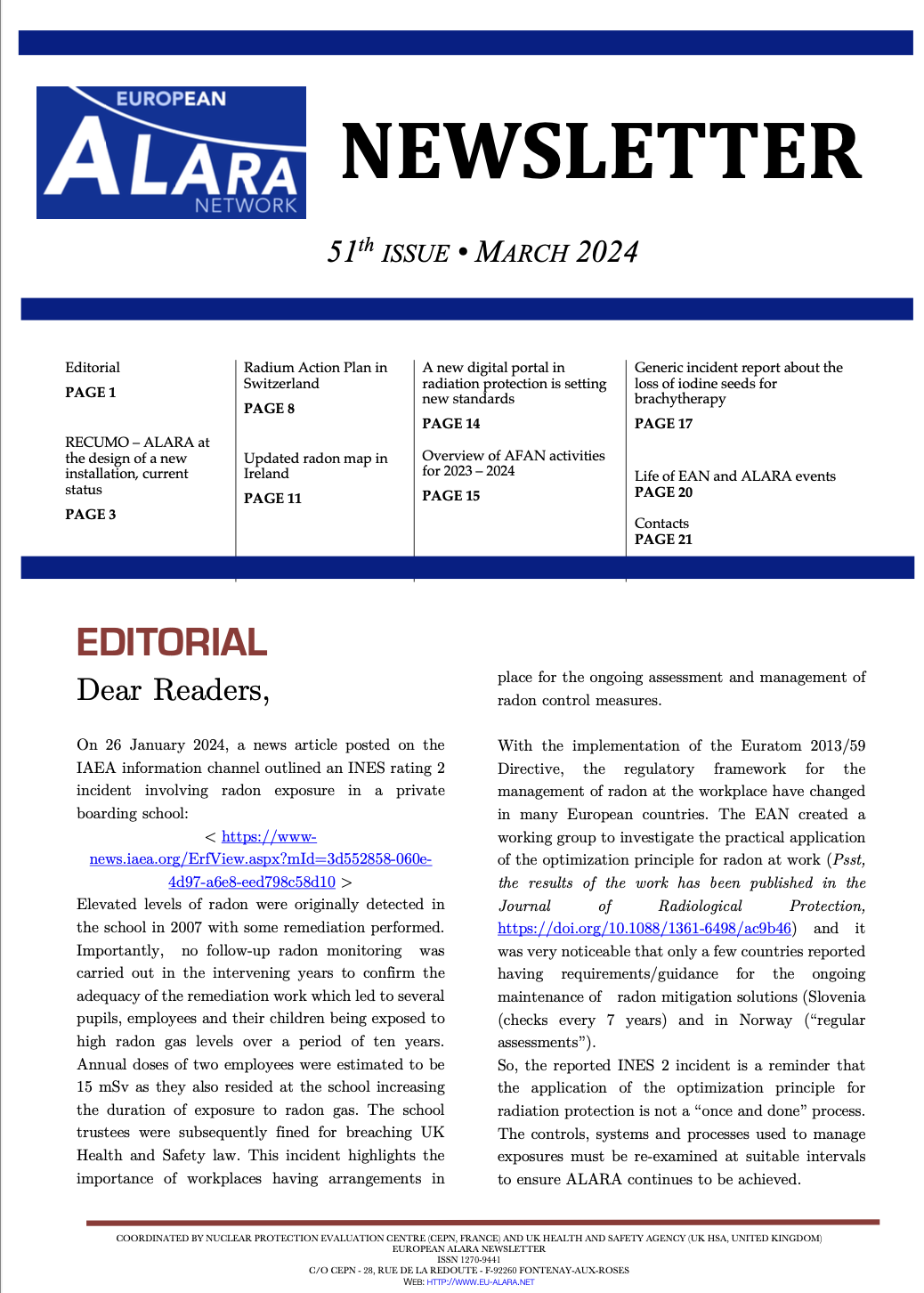
- Editorial. With a reminder that ALARA is not a "once and done" process;
- RECUMo - ALARA at the design of a new facility;
- The Radium Action Plan in Switzerland;
- Update of the radon maps in Ireland;
- A new digital portal is setting new standards (Switzerland);
- Overview of AFAN activities 2023-2024;
- Generic incident report about the loss of iodine seeds for brachytherapy;
- Life of EAN and ALARA events
- EAN contacts
The Editorial Board. —
Issue 50 - November 2023
- Details
You can access here the 50th issue of the European ALARA Network Newsletter. 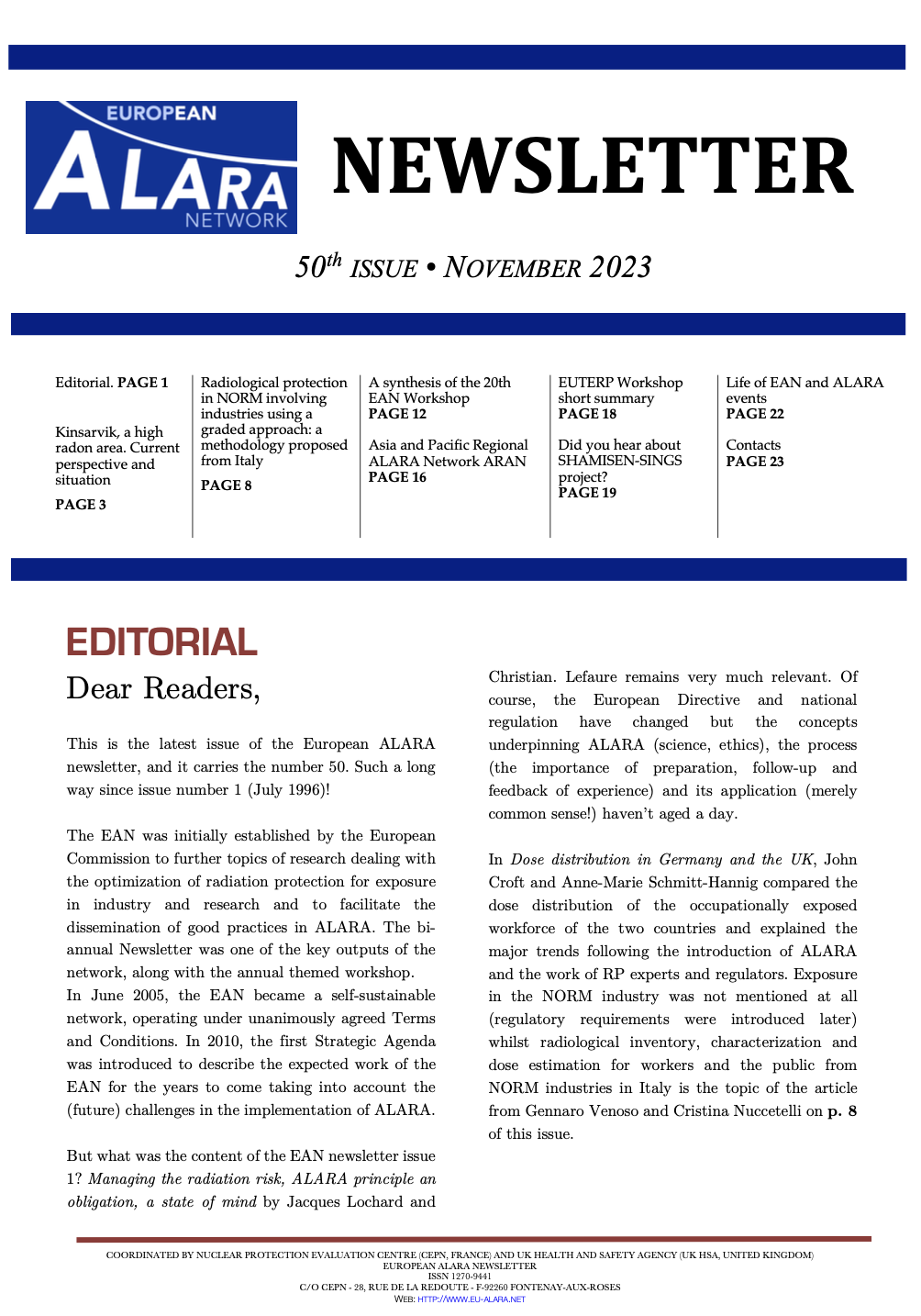
- Editorial - With a perspective on the content of EAN newsletter 1.
- Kinsarvik, a high radon area. Current perspective and situation;
- Radiological protection in NORM involving industries using a graded approach: a methodology proposed from Italy;
- A synthesis of the EAN Workshop n° 20;
- Asia and Pacific Regional ALARA Network, ARAN;
- EUTERP workshop short summary;
- Did you hear about SHAMISEN-SINGS project?
- Life of EAN and ALARA events
- EAN contacts
The Editorial Board. —
20th workshop: ALARA for interventional radiology & nuclear medicine
- Details
EAN 20th workshop ALARA for interventional radiology & nuclear medicine
Vienna, Austria, 2-4 October 2023

Aims and objectives of the workshop
The programme will develop in 4 sessions:
- Setting the scene and ALARA challenges identified in the fields of interventional radiology and new radiopharmaceuticals;
- Tools for ALARA;
- Focus on (new) radiopharmaceuticals;
- Education and training, culture.
As traditional, a significant part of the EAN Workshop will devoted to discussions in Working Groups (each participant can participate in one Working Group, to be selected at the registration). The (provisional) topics for discussion by the Working Groups are:
- The challenges for the optimization of patients AND workers in interventional radiology;
- What are the ALARA tools available in IR? Usages and usability?
- What are the elements of a good ALARA culture in (nuclear) medicine?
- Technical developments in nuclear medicine: how to instil RP from the outset?
The workshop conclusions and recommendations aims to summarise the main points of the presentations and the discussions held during the Working Groups.
The workshop was kindly hosted by the Austrian Ministry of Public Health (AGES) at the Vienna premises.

© AGES
Programme
- 'ALARA for interventional radiology & nuclear medicine' programme and practical information (Programme Committee)
Presentations
Session 1 - Setting the scene and ALARA challenges in Europe (Chairs: Mr. S. Andresz & Mrs. Julie Morgan)
- Introduction to the workshop (Mr. S. Andresz, CEPN France; Julie Morgan UKSA, United Kingdom)
- IAEA activities on RP in interventional procedures (Mr. O. Holmberg, IAEA, Austria)
- EFOMP & ALARA (Mr. A. Rogers, EFOMP)
- ALARA in medical application of ionizing radiation - the HERCA workgroup on medical application experience (Mrs. B. Godthelp, ANVS, The Netherlands)
- The Good, the Bad and the Ugly in nuclear medicine (Mrs. E. Reeves, UKHSE, United Kingdom) [restricted]
Session 2 - Tools for ALARA (Chairs: P. Allisy-Roberts & Andy Rogers)
- Medical staff exposure and monitoring in interventional practices (Mr. P. Ferrari, ENEA-RP Institute, Italy)
- Personalized nuclear medicine imaging and radionuclides therapy - A medical physicist perspective (Mr. K. Baete, University Hospital Leuven, Belgium)
- Feedback from a busy interventional radiology departement - Focus on good practices (Mrs. N. Bergans, KU Leuven; University Hospital Leuven, Belgium)
- Computational dosimetry as a tool to optimize staff RP during interventional procedures (Mr. F. Vanhavere, SCK CEN, Belgium)
- Evaluation of the performance of shielding protective equipment in interventional procedures: results from the MEDIRAD project (Mr. F. Vanhavere, SCK CEN, Belgium)
- Current technologies reducing dose in IR (Mr. A. Rogers, Nottingham University Hospitals/NHS, United Kingdom)
- Managing occupational and patient dose in an integrated manner (Mrs. H. Bosmans, University Hospital Leuven, Belgium)
- Introduction to the working groups (Mr. S. Andresz, CEPN)
Session 3 - Focus on (new) radiopharmaceuticals (Chairs: Mr. N. Stritt & Mr. S. Andresz)
- Promising radionuclides for radiopharmaceuticals in the future (Mr. D. Müller, Seibersdorf Lab. Austria)
- Extremities doses in nuclear medicine - Influence of new radionuclides (Mr. R. Kolaard, NRG, The Netherlands)
- The management of new radionuclides in medical trials: radiopharmacy perspectives (Mrs. R. R. Membrive, Clinica Universidad de Navarra, Spain)
- Operational radiation protection at MEDICIS - A CERN facility for the production of non-conventional isotopes for nuclear research (M. Widorski, CERN, Switzerland)
- Radiation protection for new radiopharmaceuticals in nuclear medicine (Mr. C. Michel, Radiation Protection and Nuclear Safety Institute, France)
- Emerging radioisotopes in radiopharmaceuticals research - a preclinical perspective (Mrs. V. Rosecker, King's College London United Kingdom)
- Upcoming radiation protection issues with new radiopharmaceuticals drugs (Mrs. S. Terry, King's College London, United Kingdom) [restricted]
Session 4 - Education, training and culture (Chairs: Mrs. C. Schieber & Mr. S. Economides)
- HERCA E&T WG on radiation protection (Mr. S. Economides, GAEC, Greece)
- European Training and Education for Medical Physics Experts in Radiology (EUTEMPE-RX) (Mrs. H. Bosmans, University Hospital Leuven, Belgium)
- Radiation safety culture in interventional radiology - perspective from the UK and the IRPA TG (Mrs. C-L Chapple, Newcastle Hospital, NHS, United Kingdom)
- Development and framework for the continuing training of medical professionals on patient's protection (Mrs. K. Tack, Nuclear Safety Authority, France)
- Receptivity to expert advice, education and training is highly dependent on situational and cultural context (Mr. H. Wilkins).
Session 5 - Working Groups Reports
- The challenges for the optimization for patients and workers in interventional radiology (report from Working Group 1)
- What are the elements of a good ALARA culture in medicine? (report from Working Group 3)
- Technical development in nuclear medicine: how to instil RP from from the outset? (report from Working Group 4)
- Preliminary conclusions and recommendations (J. Morgan, UKHSA, United Kingdom; S. Andresz, CEPN)
Issue 49 - March 2023
- Details
You can access here the 50th issue of the European ALARA Network Newsletter.
- Editorial - What is ALARA according to ChatGPT
- Restriction of exposure in veterinary practice;
- Future challenge in theragnostic centres taking into account all the radiological protection measures;
- Introducing EAN Workshop n° 20 on Interventional Radiology & Nuclear Medicine;
- A synthesis of the European ALARA Network 1st webinar
- Relations with other organisations: annouvement of ETRAP conference
- Life of EAN, next events;
The Editorial Board. —
Workshop 19' (webinar) "Challenges in applying the radiation protection system in the management of NORM and radon", online, 8 December 2022
- Details
WHY THIS TOPIC? — The International Commission on Radiological Protection system of protection is based on three fundamental principles: justification, optimisation and dose limitation; they apply to three types of situations of exposure to ionising radiations: (those that can be) planned, (in case of) emergency and existing (from sources that already exist when decisions to control them are made) along with three categories of exposures: occupational (i.e. workers), medical patients and the public (ICRP, 2007, ICRPedia).
Radon and NORM (naturally occurring radioactive materials) exposures have been categorized by ICRP as existing exposure situations (ICRP 2014; 2016; Lecomte, 2016; ICRP, 2019). However, both types of sources present specificities, making the choices about the type of exposure situation and the categories of exposure somewhat challenging and areas of confusion [Cool, 2013]. In some circumstances (for example in [Euratom, 2013]), radon and NORM are considered as planned exposure situations and exposure controlled as such. ICRP has recognized that further clarity is needed on the interpretation of exposure situations [Clément, 2021].
ICRP has insisted that the optimisation principle is a systematic process that apply irrespectively of the exposure situation: fundamentally, the exposure of the individuals should always be kept ALARA below certain dose criteria, be it called “reference level” or “dose constraint” depending on the case. Nonetheless, the protection strategy should be designed based on the characteristics of the situation and the circumstances of the exposure and a graded approach might be appropriate.
The application of the optimisation principle is the cornerstone of the activities of the European ALARA Network. Furthermore, the EAN also aims to assist ICRP in the practical implementation of its recommendations and to monitor the development of the new general recommendations [EAN, 2021], as a Special Liaison Organisation.
OBJECTIVE — The EAN would like to examine how the optimisation principle has been applied in the case of NORM and radon (at workplace or in other circumstances) and whether the choices of exposure type and exposure categories affect the practical implementation of ALARA.
A webinar will be organised to present an overview of experiences and discussed if the elements of the optimisation process could be influenced by the type of exposure situation/categories of exposure:
- Selection of the appropriate dose criteria (dose constraint, reference level);
- Dose assessment;
- Identification of the protective options and selection of the best option;
- Implementation, monitoring of exposure and iteration.
PROGRAMME. — The programme of the webinar is available: here.
RESULTS. — In total 168 participants have registered to the webinar and almost 110 attended the live 8 December 2022. AGES, Austria have provided an in-kind and very welcome support for the registration and holding the webinar.
The replay of the webinar is available: https://www.youtube.com/watch?v=g9fdblFRUOY (duration: 2 h 20').
The slideshows are also available:
- The philosophy of the ICRP system applied to NORM and Radon, Mr. J F Lecomte, IRSN, France (pdf);
- Practical experience from Norway in NORM remediation, Mrs. M V Holmstrand, DSA, Norway (pdf);
- Feedback on radiation protection for NORM facilities and underground workplaces, Mrs. K N Rovenská, SURO, Czech Republic & RadoNorm partner (pdf);
- Radon potential map of the UK - updating and implementation, Mrs. T Gooding, UKHSA, United Kingdom (pdf);
- Optimization in protection from radon: problems and proposals, Mr. F. Bochicchio, ISS, Italy (pdf).
- A synthesis of the presentation and discussions will be produced and published here. ◼︎
REFERENCES.
Clement, 2021. Keeping the ICRP recommendations fit for purpose, C. Clement et al. 2021 Journal of Radioogical Protection 41 1390.
Cool, 2013. Review of the ICRP system of protection: the approach to existing exposure situations, D. A. Cool, March 2015, Annals of the ICRP 44(1 Suppl).
EAN, 2021. European ALARA Network Strategic Agenda 2021-2026.
Euratom, 2013. Council Directive 2013/59/Euratom of 5 December 2013 laying down basic safety standards for protection against the dangers arising from exposure to ionising radiation, Official Journal of the European Union, L 013, 17 January 2014.
ICRP, 2007. The 2007 Recommendations of the International Commission on Radiological Protection. ICRP Publication 103. Ann. ICRP 37(2–4).
ICRP, 2014. Radiological Protection against Radon Exposure. ICRP Publication 126. Ann. ICRP 43(3).
ICRP, 2019. Radiological protection from naturally occurring radioactive material (NORM) in industrial processes. ICRP Publication 142. Ann. ICRP 48(4).
ICRPedia, http://icrpaedia.org/Exposure_Categories_and_Situations, June 2019.
Lecomte, 2016.J. F. Lecomte, Understanding existing exposure situations. Annals of the ICRP 2016 45:1_suppl, 54-63.
Working Group: ALARA for Radon At Work
- Details

L. Davidson, 2020, Free to use under Unsplash Licence.
Why a Working Group?
Exposure to radon represents an important contribution to the exposure of the public and the workers to ionizing radiation. In Europe, the national regulations for the protection of workers against exposure to ionizing radiation and radon in particular have been updated with the implementation of the Council Directive 2013/59/Euratom. Compared with the former Directive, the number of workplaces potentially concerned by the regulation has increased and now include many workplaces not previously aware of radioactivity and without a radiation protection system in place. The management of radon can be challenging in practice and even for radiation protection specialists, radon might not be an easy problem to solve.
Therefore, it seems appropriate for the European ALARA Network (EAN) to engage the collection of the early feedbacks of the application of the new regulatory framework to identify why questions are raised and where difficulties are met to share it to a wider audience. This action could also be the opportunity to collect good practices to address radon and share it at the same time.
Actions engaged
In March 2021, the Working Group ALARA for Radon at the Workplace (A-RAW) was set up. The working group developed a survey instrument to collect elements from national regulation and case studies in the management of radon. The working group actively disseminated the survey and collected feedbacks from Radiation Protection Authorities/Agencies (RPA) and National Insurance Fund. A synthesis of the collected feedbacks have been elaborated.
The objectives of the working group include sharing the results and the members are looking for the opportunities to present the result in conference and by the publication of an article.
Documents produced
- Minutes of the Meeting n°1, including the term of reference of the working group, March 2021
- Minutes of the Meeting n°2, June 2021
- Survey instrument, June 2021
- Minutes of the Meeting n°3, September 2021
- Data collected from 7 countries: Belgium, France, Ireland, Norway, Slovenia, Switzerland, United-Kingdom
- Abstract to IRPA Budapest Conference and presentation (2 June 2022)
- Presentation at ROOMS conference (27 September 2022)
- Application of the ALARA Principle for radon at work: feedback from the European ALARA Network, S. Andresz, J. Morgan, C. Nuccetelli, M. Palacios, C. Schieber, M. Sneve, N. Stritt, H. Synnott and F. Vermeersch, Journal of Radiological Protection, Accepted manuscript online, https://doi.org/10.1088/1361-6498/ac9b46
Issue 47 - April 2022
- Details
You can access here the 47th issue of the European ALARA Network Newsletter. 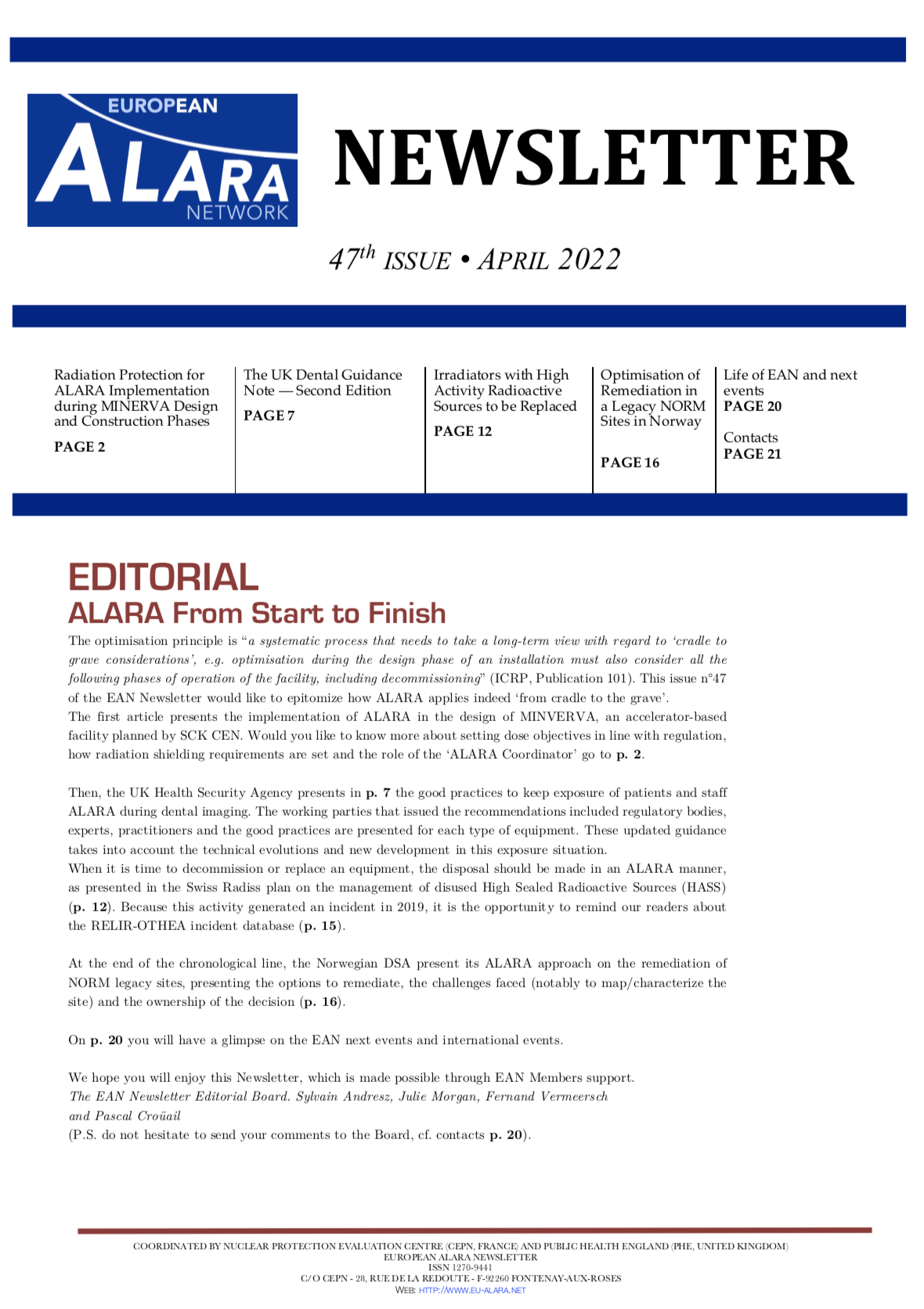
- Radiation Protection for ALARA implementation during MINERVA Design and Construction Phases;
- The United Kingdom Dental Guidance Note - 2nd edition;
- Irradiators with High Activity Sources to be Replaced
- Optimisation Actions of Remediation in a Legacy NORM site in Norway
- Life of EAN and relations with other organisations
The Editorial Board
Issue 45 - April 2021
- Details
You can access here the 45th issue of the European ALARA Network Newsletter. 
-
The Graded approach for workplaces in the context of the implementation of Directive Euratom 2013/59
-
Contamination incidents during injection of radoopharmaceuticals an OTHEA/RELIR incident
-
Reminder about the OTHEA/RELIR
-
Action Plan to strengthen the radiological safety and security (of sources) in Switzerland (RADISS)
-
Fukushima+10 list of events
-
Life of EAN and relation with other organizations.
Issue 44 - November 2020
- Details
You can access here the 44th issue of the European ALARA Network Newsletter. 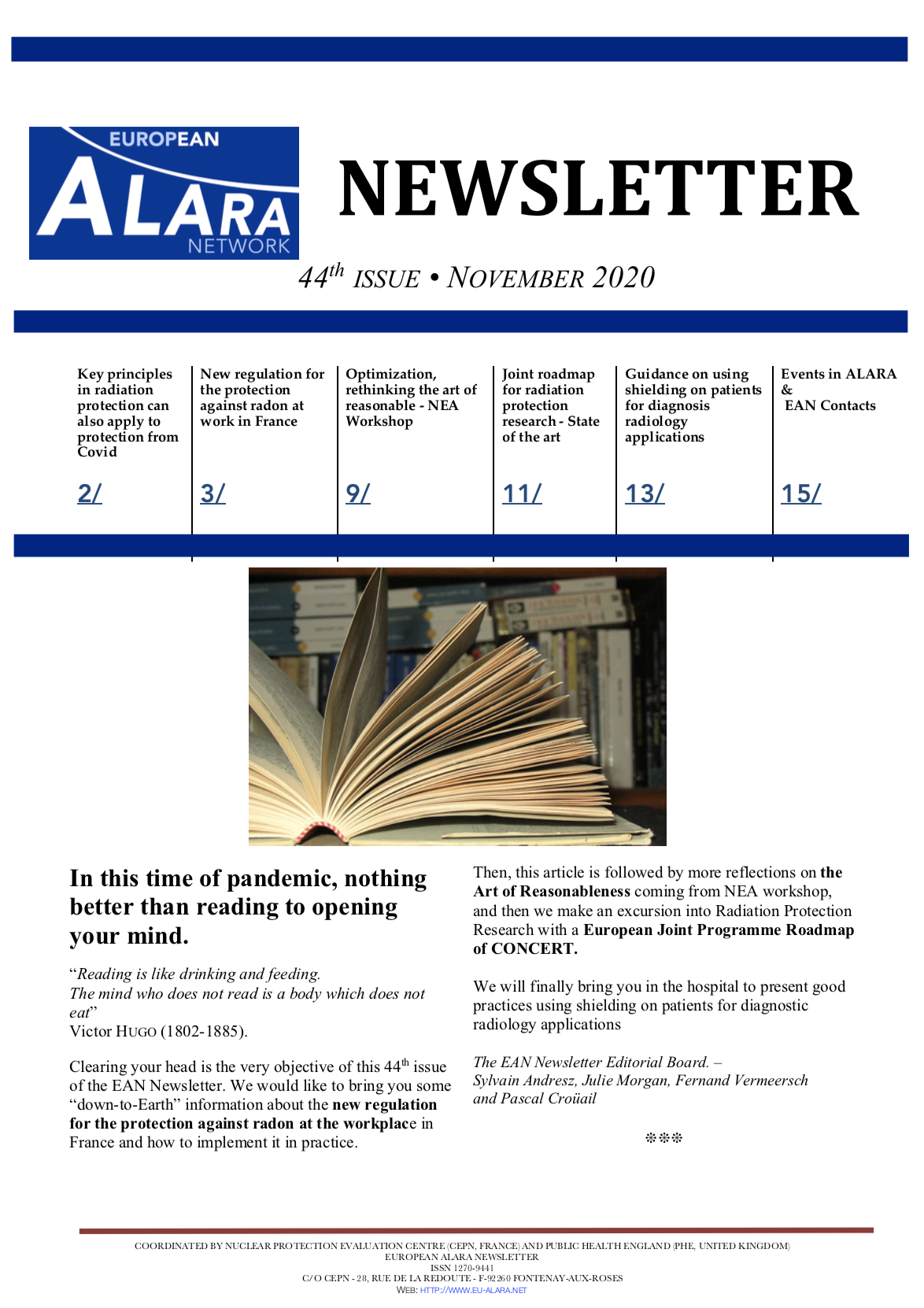
-
key principles in radiation protection can also apply to protection from Covid
-
new regulation for the protection against radon at work in France
-
optimization, rethinking the art of reasonable - NEA workshop
-
joint roadmap for radiation protection research - state of the art
-
guidance on using shielding on patients for diagnosis radiology applications
-
Events in ALARA
Issue 43 - June 2020
- Details
You can access here the 43th issue of the European ALARA Network Newsletter. This is a special issue on the challenges on ALARA in the context of the Covid-19 pandemic. 
- The Impacts of Covid-19 pandemic on ALARA - Testimonies from EAN Members:
- Testimony from Austrian Agency for Health and Food Safety, Mr. F. Kabrt, Mrs E. Linder-Leschinski.
- Testimony from Nuclear Protection Evaluation Centre, France, Mr. S. Andresz.
- Testimony from Environmental Protection Agency, Ireland, Mr. H. Synnott.
- Testimony from Swiss Federal Office of Public Health, Mr. N. Stritt and colleagues.
- Testimony from Public Health England, Mrs. J. Morgan.
-
A Glimpse on Initiatives taken by several RP-related Organizations during the Covid-19 Pandemic
- IAEA Webinars: Maintaining the Highest Level of Radiation Protection During the Covid-19 Pandemic, Mr. O. Burcin, Mrs. L. Doicanova, IAEA
- Other initiatives : SHARE, SRP in United Kingdom, SFRP and EDP Sciences, World Nuclear News.
-
The Radium Action Plan in Switzerland 2015-2022, Mr. N. Stritt, Mrs. M. Palacios and colleagues
-
What's new in EAN?